| Filter Point Mats (FP) |
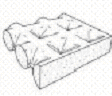 |
Two layers of fabric are woven together at regularly spaced intervals. These points of attachment serve as filter points allowing upward passage of ground water from beneath the mat to reduce hydrostatic uplift.
Filter points are placed in a diamond pattern.
After mortar is injected, the pattern of the mat takes on an attractive diagonal grid appearance.
|
| Non-Filter(NF)Mat |
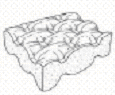 |
Two layers of fabric are
laced together by drop stitches to form a
waterproof mat eliminating single-layer portions.
NF50: The two layers are laced together at
close intervals to form a slab with a smooth,checkerboard
appearance after being injected with mortar.
NF100 and NF150:The drop-stitched portions
are partially grouped together so that the
finished slab is given a lumpy, lattice pattern.
|
| Concrete Mat(CX)=Storm Mat |
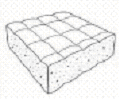 |
CX fabric is used for constructing concrete slabs. It is filled with injected concrete containing coarse aggregate with a maximum size from 10 |
| Revetment Greenification (GP) Mat |
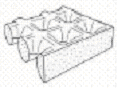 |
Two fabric layers are
woven together to a single layer
is formed in advance at the factory, and a hydrostatic
uplift preventing material (nonwoven fabric,t=10mm)is
used so as to produce a slope revetment friendly
to nature combining the slope protection of
a conventional fabriform plus a vegetation
planting function. |